

Germanwatch's CCPI is publicly referenced by financial institutions and used in academic research





Key features
SovereignPath offers five core analytical features designed to help users quantify sovereign climate alignment and integrate it into strategic decision-making.
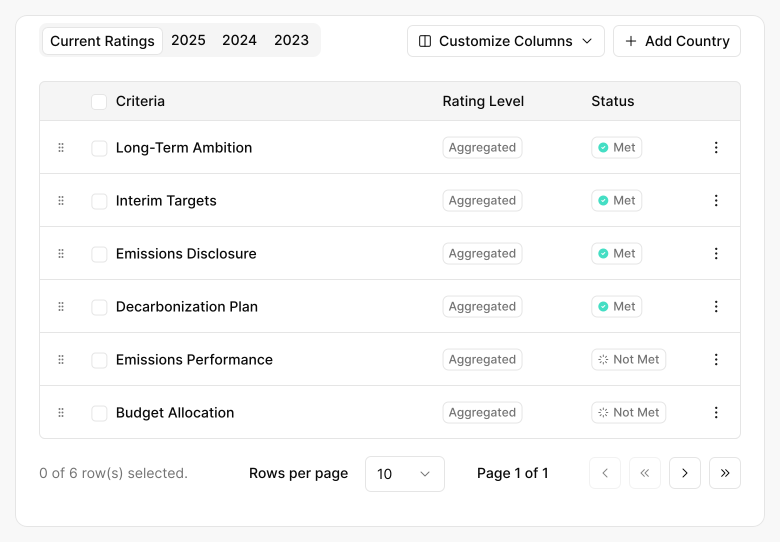
Full transparency
Know exactly where each country stands: All six NZIF criteria are individually assessed, revealing which requirements are fulfilled or missing. Enables focused analysis of sovereign progress and policy gaps.
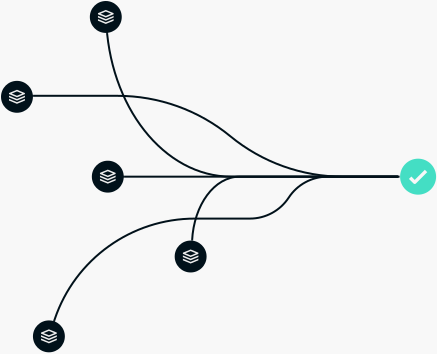
Fair share methodology
Scientific differentiation across economies: Our fair share model accounts for income levels, historical emissions, and capability to ensure equitable assessment between developed and emerging markets.
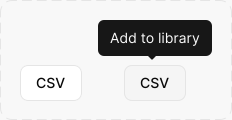
CSV delivery
Seamless integration, zero friction: No IT project required. No platform training. No onboarding delays. Ready for immediate use.
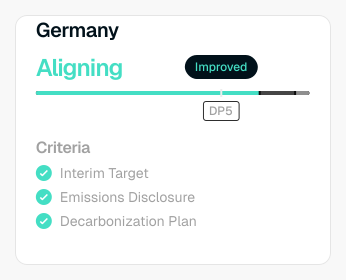
Change tracking
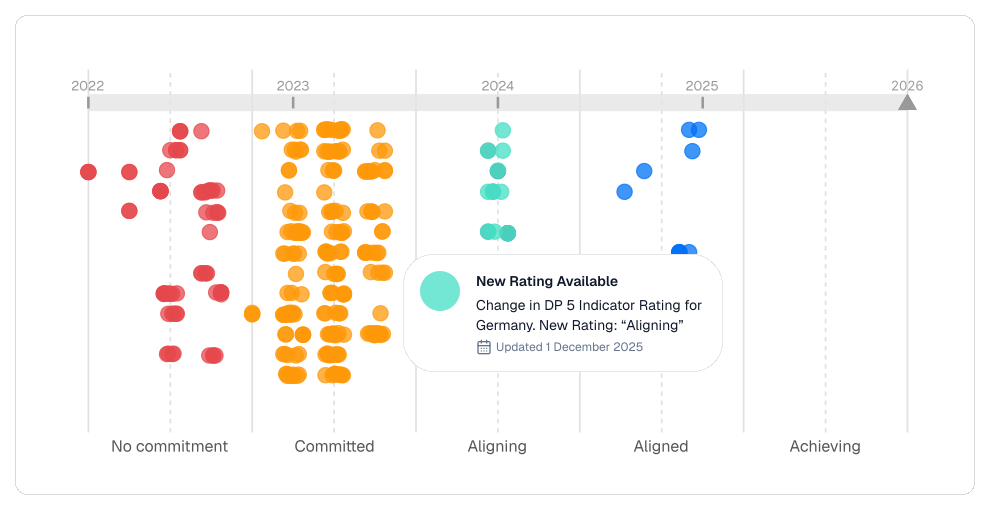
See who is moving: Sovereign climate risk is not static. Countries upgrade their NDCs. Governments change. Policies shift.
Independently verifiable
Defensible data sourcing: Maintain complete traceability to recognized and verified data sources, including the CCPI.
How it works
SovereignPath applies a transparent, stepwise logic. Each country’s rating reflects how fully it meets the six NZIF criteria, using indicator-based input data and respective evaluation thresholds.
Criterion 1. Long-Term Ambition (LA)
What it measures: Strength and credibility of net-zero commitments
Key question for investors: Has the country adopted a target aligned with <2°C?
Criterion 2. Interim Targets (IT)
What it measures: Near-term emission reduction goals (e.g., 2030 NDCs)
Key question for investors: Are short-term targets consistent with the country's fair share pathway?
Criterion 3. Emissions Disclosure (ED)
What it measures: Reporting frequency and transparency
Key question for investors: Does the country meet UNFCCC disclosure requirements on time?
Criterion 4. Decarbonization Plan (DP)
What it measures: Policy measures and implementation readiness
Key question for investors: Are renewable energy, energy efficiency, and transition policies actually in place and stable?
Criterion 5. Emissions Performance (EP)
What it measures: Recent GHG trajectory (last 5 years)
Key question for investors: Is the country's current emissions trend compatible with its fair share pathway?
Criterion 6. Budget Allocation (BA)
What it measures: Capital flows toward transition
Key question for investors: Is national investment shifting away from fossil fuels toward renewables?
Validated through 9-month institutional beta
Validated through a rigorous beta with leading fixed-income investors across Europe, North America, and Australia to ensure methodological robustness and usability before market release.
Portfolio Management
Global Fixed Income Team
"The framework brings analytical clarity to sovereign climate alignment. The True/False indicator structure makes complex criteria immediately interpretable.”
Use case: Benchmark government debt allocations against net-zero pathways to detect early signs of alignment and misalignment.
RISK
ESG Analyst
"[...] a sovereign-level tool that combines scientific rigor with usability. The documentation behind each indicator gives us confidence in reporting portfolio alignment.”
Use case: Set credible net-zero targets for sovereign bond portfolios and climate performance for annual disclosure, stewardship, and client reporting.
RESEARCH
Head of Sustainability Analytics
"The historical data and indicator transparency make this stand out. It is a solid foundation for consistent climate reporting across years."
Use case: Integrate sovereign alignment scores as a climate-risk variable in fixed-income models to explore correlations with financial KPIs.
Built for your workflow
Set credible targets
Develop 5Y-alignment targets in line with
IIGCC’s disclosure expectations.
Screen at portfolio-level
Assess your holdings and get an instant alignment heatmap.
Receive as CSV or Excel
Plug ratings directly into your existing risk models and ESG dashboards.
Frequently asked questions
Common questions from beta users of the SovereignPath database, addressing methodology, data coverage, and practical applications.
What is the intended use of SovereignPath results?
The tool is designed for sovereign fixed-income teams and ESG analysts seeking to implement the IIGCC framework in internal and external analysis. Ratings can be used to quantify sovereign-level climate alignment and progress over time, inform strategic decision-making and engagement priorities. (Note: The rating is not an economic or credit assessment, but a climate-alignment evaluation grounded in transparent, science-based criteria).
How is the SovereignPath rating structured?
SovereignPath applies a criteria-based rating framework that mirrors the guidance of the IIGCC Net Zero Investment Framework 2.0. Each country is evaluated across six criteria: 1. Long-Term Ambition, 2. Interim Targets, 3. Emissions Disclosure, 4. Decarbonization Plan, 5. Emissions Performance, and 6. Budget Allocation. These criteria are quantified through underlying indicators (e.g. Paris ratification, 2030 target alignment, national policy quality) and aggregated into one of five rating outcomes: Achieving, Aligned, Aligning, Committed, and No Commitment, representing the degree of consistency with a “well-below 2 °C” pathway.
Can users access historical ratings to track changes over time?
Yes. SovereignPath provides historical results from 2022 to 2026, allowing users to analyse progress and changes in both country-level performance and portfolio-level alignment. Tracking year-on-year developments helps identify whether shifts in alignment are driven by policy changes, target updates, or data revisions, a key input for annual climate reporting and engagement analysis.
Is indicator-level data available alongside the overall rating?
Yes. Each country’s SovereignPath score is derived from transparent indicator-level assessments, available to users upon request. This data enables users to verify the underlying evidence behind each criterion, supporting detailed climate reporting and internal data validation.
How does the methodology address fairness between developed and emerging economies?
SovereignPath integrates fair share considerations at the level of indicators and pathways, following the Common but Differentiated Responsibilities and Respective Capabilities (CBDR-RC) principle. Country-specific “well-below 2 °C” pathways are derived using the Common but Differentiated Convergence (CDC) approach (Höhne et al., 2006). This means developed countries are assessed against earlier convergence points, while emerging economies are evaluated from later baselines to reflect differing capacities and historical responsibilities. In addition, the criteria for long-term ambition and emissions disclosure apply more flexible requirements to EMDEs, and the assessment of policy performance explicitly considers national capabilities.
© 2025 ausblick capital GmbH. All rights reserved.